We often talk about muscle in relation to appearance, strength, or athletic performance. But skeletal muscle is also one of the body's largest and most important metabolic organs. It regulates glucose, drives inter-organ signaling, and preserves physical independence as we age.
Instead of asking, "How much weight have I lost?" — a far more meaningful question is: "What kind of weight am I losing, and am I preserving my muscle and strength?"
1. Skeletal Muscle Is a Major Site of Glucose Disposal
After a carbohydrate-containing meal, insulin signals GLUT4 transporters to move to muscle cell membranes, allowing glucose to enter for immediate energy or glycogen storage.
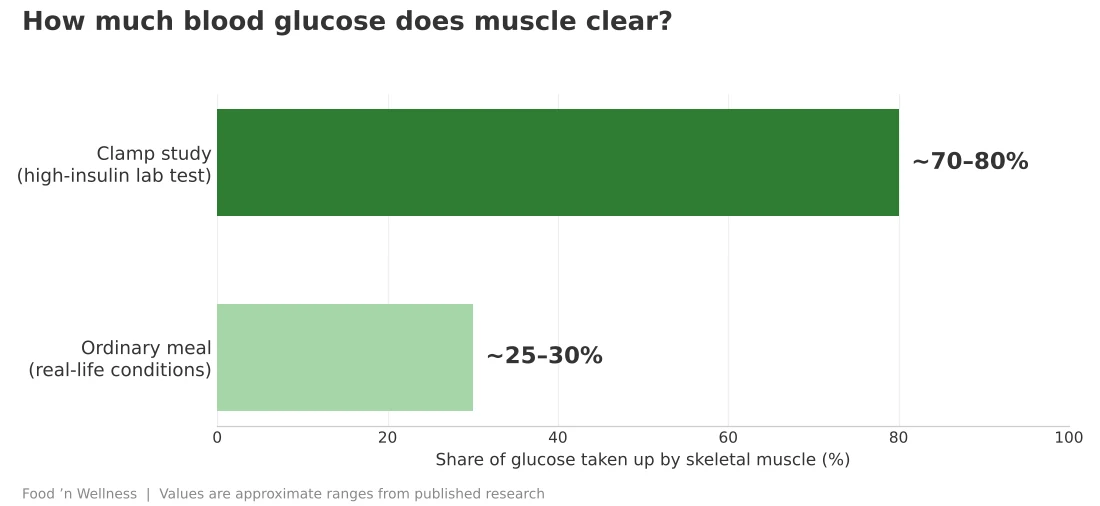
Muscle's contribution to glucose disposal:
- Hyperinsulinaemic-euglycaemic clamp: ~70–80%
- Ordinary post-meal conditions: ~25–30% (varies by diet, activity, and insulin sensitivity)
Insulin Resistance: Impaired muscle glucose uptake leads to elevated circulating blood glucose and compensatory hyperinsulinaemia — a core driver of type 2 diabetes.
The Contraction Pathway: Muscle contraction stimulates GLUT4 translocation independently of insulin, allowing physical activity to improve glucose handling immediately — even before body composition changes.
Practical Application: You don't need exhausting workouts after every meal. Short 10–15-minute post-meal walks, standing breaks, or light household activity engage large leg muscles to help clear circulating glucose. Pair them with low glycemic index meals for an even gentler blood-sugar curve.

2. Muscle Is an Active Signaling Organ
When muscle contracts, it releases myokines — signaling molecules that coordinate communication with the liver, pancreas, fat tissue, bone, immune system, and brain.
Exercise-Induced IL-6: Unlike chronically elevated, inflammatory IL-6, exercise-associated IL-6 acts transiently to mobilize fuel, increase fat oxidation, and stimulate anti-inflammatory cascades.
Complex Pathways: Myokines like irisin and BDNF play key roles in metabolism and cognitive support, though exercise–brain communication operates through broad, multi-organ networks rather than direct, isolated pathways.
3. Muscle Supports Metabolism (Without "Skyrocketing" Calorie Burn)
While muscle is metabolically active, its resting energy expenditure is modest. Adding a few kilograms of muscle will not burn hundreds of extra calories per day at rest.
By the numbers: At rest, 1 kg of skeletal muscle burns roughly 13 kcal a day, compared with about 4.5 kcal for 1 kg of fat. Gaining 2 kg of muscle adds only around 25 kcal a day.
The true metabolic value of muscle lies in:
- Fuel utilization
- Force generation
- Exercise capacity
- Maintaining total daily energy expenditure during weight loss
4. Weight Loss vs. Fat Loss
Scale weight includes fat mass, skeletal muscle, organs, water, glycogen, and gastrointestinal contents.

Lean Mass vs. Muscle: "Lean mass" (fat-free mass) includes body water, bone, and organs — not just skeletal muscle. A decline in DXA-measured lean mass does not equate solely to muscle loss.
Risks of Aggressive Deficits: Rapid scale loss from severe caloric restriction risks strength loss, nutrient deficiencies, fatigue, and muscle degradation. The goal of weight loss should be reducing excess body fat while preserving functional tissue.
5. Muscle Strength & Function Drive Healthy Aging
Muscle mass naturally decreases with age, but strength declines faster than mass. Sarcopenia — the clinical loss of muscle strength, quantity, and performance — is evaluated via functional markers rather than body-fat scales alone.

Diagnostic cut-offs:
- Handgrip strength (low): Men <27 kg, Women <16 kg
- Handgrip strength, Asian framework (low): Men <28 kg, Women <18 kg
- Five-chair-rise time (low): >15 seconds for both men and women
Quick self-check: Time yourself standing up from a chair five times without using your arms. Taking longer than 15 seconds is a signal to get your strength assessed.
BMI Limitations: A normal BMI can hide sarcopenia, while a high BMI can coexist with poor muscle health (sarcopenic obesity), compounding metabolic and functional risks. Read more on nutrition for healthy aging.
6. Women Should Prioritize Muscle in Midlife
Perimenopause and menopause bring hormonal shifts, reduced muscle protein turnover, and increased central fat distribution. Women remain fully capable of building strength and muscle post-menopause.

Nutrition and training should focus on protein distribution, progressive loading, and recovery — rather than excessive cardio and restrictive diets. Strength training also helps protect against osteoporosis.
7. GLP-1 Therapy & Body Composition
GLP-1 receptor agonists and dual-incretins drive substantial weight loss, which naturally includes both fat and lean mass.
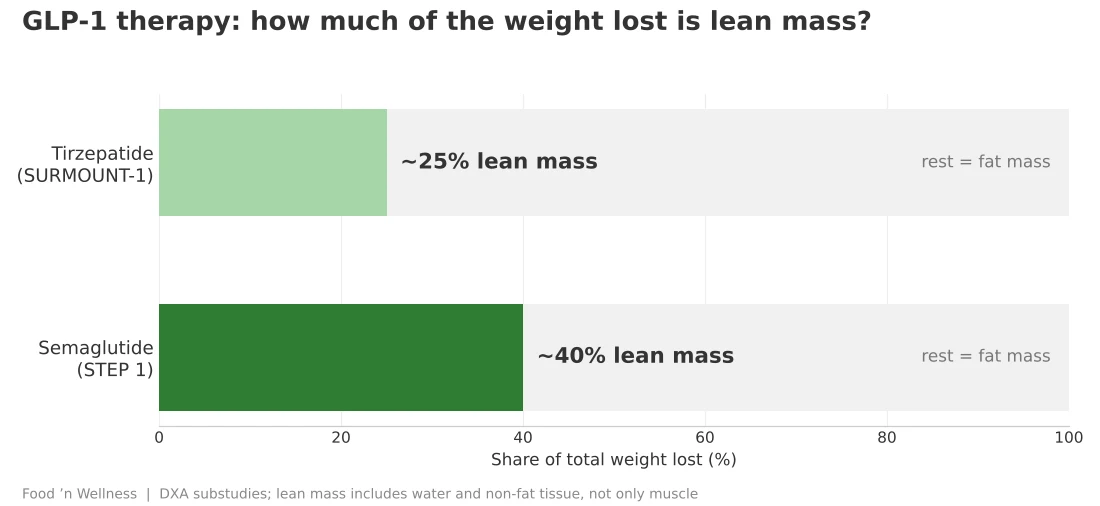
Clinical data — lean mass lost as a share of total weight lost:
- STEP 1 DXA substudy (Semaglutide): ~40%
- SURMOUNT-1 DXA substudy (Tirzepatide): ~25% (inclusive of water and non-fat tissues)
Current Guidelines: A 2025 multi-society advisory (ACLM, ASN, OMA, TOS) recommends pairing GLP-1 therapies with adequate protein, nutrient-dense foods, and structured resistance training.
Key Rule: Protein supplies amino acids, but muscle requires a mechanical stimulus (resistance loading) to be retained.
8. Individualized Protein Strategy
- Target range (during weight loss): 1.2–1.6 g/kg/day (using adjusted or ideal body weight for severe obesity)
- Distribution: Spread protein across meals to provide repeated opportunities to stimulate muscle protein synthesis (MPS)
- Leucine & quality: Aim for complete protein sources (eggs, dairy, poultry, fish, tofu, paneer, lentils, or quality supplements)
- MPS trigger: A meal supplying ~2.5–3 g of leucine optimally triggers MPS via mTORC1
What this looks like: For a 60 kg woman, 1.2–1.6 g/kg works out to about 72–96 g of protein a day, or roughly 24–32 g at each of three main meals.

Start the day with a protein-rich crunchy dosa or sprouts spinach tikkis, and keep lunch and dinner on track with a bowl of vegetable lentil soup or a quinoa lentil dosa.
9. Resistance Training Is Non-Negotiable
Protein provides the raw building blocks; resistance training provides the adaptation signal.

Progressive Overload: Gradually increase resistance, reps, sets, or time under tension over time.
Core Movements: Prioritize fundamental patterns — squats, lunges, hip hinges, pushes, pulls, and core stability — 2–3 times per week. See our guide to pre-exercise nutrition to fuel your sessions.
10. The Complementary Role of Walking
- Resistance training: Muscle hypertrophy, strength, bone density, structural preservation
- Walking: Cardiovascular health, mental well-being, postprandial glucose management
Quick Muscle-Preservation Checklist
- Train Strength: Perform progressive resistance exercise 2–3 times weekly.
- Distribute Protein: Include a distinct protein source at every main meal (targeting ~1.2–1.6 g/kg/day).
- Avoid Crash Deficits: Keep caloric deficits moderate to protect performance and tissue.
- Move Daily: Take 10–15-minute walks after meals to manage postprandial glucose.
- Track Function: Measure progress by handgrip, chair-rise time, and energy — not just scale weight.
Key Takeaways
- Muscle is a metabolic organ: It plays a direct role in glucose disposal, insulin sensitivity, and inter-organ crosstalk.
- Quality over speed: Fast weight loss often sacrifices functional tissue; prioritize fat loss over scale loss.
- Stimulus + Material: Protein alone cannot preserve muscle without progressive resistance training.
- Focus on Function: Strength, mobility, and metabolic resilience are better markers of health than the lowest number on a scale.
Need a personalized plan? Our dietitians can build a protein and training-friendly meal plan around your goals, whether that's healthy weight management, managing diabetes or nutrition for healthy aging.
Medical Disclaimer: This content is for educational purposes only and does not replace personalized clinical advice. Individuals with kidney disease, liver conditions, or complex medical needs should consult their healthcare team before modifying protein intake or exercise routines.